Paying for elderly care is one of the biggest costs many families face, and it often comes with service tax on top. Budget 2027 includes two measures to bring that cost down: a lower service tax rate, and an exemption for fees up to a set limit.
What was announced
From 1 January 2027 (proposed), two changes apply to elderly care services:
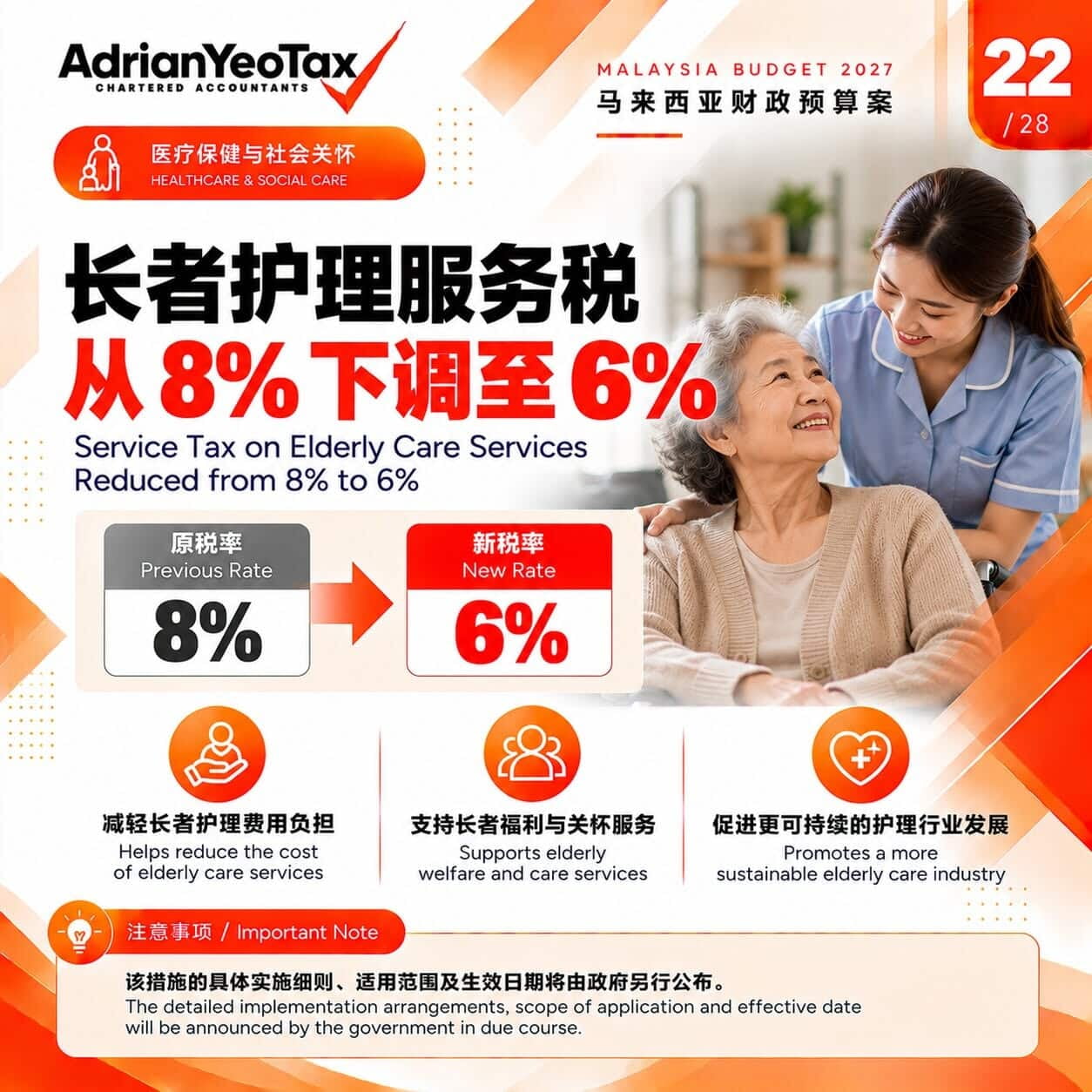
- Lower rate. Service tax on elderly care services falls from 8% to 6%.
- Exemption. Registered centres charging annual care fees of up to RM96,000 per person (RM8,000 a month) will be exempt from service tax, subject to conditions. Amounts above the threshold are expected to be taxed at 6%.
Elderly care services are also being moved to a new classification under the service tax regulations. They are currently taxed under the wellness centre category.
Which centres qualify for the exemption?
The exemption is for centres registered under either of these laws:
- the Care Centres Act 1993, or
- the Private Aged Healthcare Facilities and Services Act 2018.
The reports on the measure name registered care centres, and do not mention home care. Families who pay a carer at home should not assume the exemption applies to them. The registration threshold for charging service tax stays at RM500,000, so some smaller homes may not charge service tax at all.
What it could save
Here is a simple illustration, based on our own arithmetic. A family pays RM4,000 a month for a parent’s place in a registered care home, which is RM48,000 a year. Under the current 8% rate, service tax adds RM3,840 a year. Under the proposed exemption, that service tax would not be charged, so the saving is about RM3,840 a year. For a home charging more than RM8,000 a month, the treatment of the amount above the threshold is not yet fully clear.
What is still unclear
Several important points will depend on the final rules:
- Fees above RM96,000. The tax measures say amounts above the threshold are taxed at 6%, but it is not yet clear whether the 6% applies only to the excess or to the whole fee.
- Conditions. The exemption is subject to conditions, and the process for providers to apply is still to be announced.
- Transition. For contracts, advance payments and invoices that straddle 1 January 2027, transitional rules are expected.
- Legislation. These are proposals until they are gazetted.
Related measures for families
Budget 2027 also supports elderly care in other ways:
- Tax relief for parents’ and grandparents’ care is widened to cover all types of care expenses, not only medical costs, up to RM8,000. See our earlier post for details.
- Two National Integrated Care Centres of Excellence will be set up in Penang and Sarawak.
- More than RM40 million will go towards training 8,000 people in elderly care.
What families should do now
- Ask your care home about its registration. Find out which Act it is registered under, and whether it charges service tax today.
- Keep every bill and receipt from 1 January 2027. They support both the service tax position and the income tax relief for parental care.
- Compare costs carefully when choosing a provider, and check how fees are shown, with or without service tax.
- Wait for the implementing rules before assuming the exemption covers your situation.
What care providers should do now
- Review your classification, rate and exemption settings in your invoicing systems.
- Check your registration status under the relevant Act.
- Review existing contracts and advance payments that straddle 1 January 2027.
- Watch for the detailed rules from the Royal Malaysian Customs Department.
Speak to AdrianYeo Tax
Whether you are a family planning for a parent’s care or a provider adjusting to the new rules, our chartered accountants can help you understand the tax impact and plan ahead.
This article is for general information only and does not constitute tax advice. Measures are based on Budget 2027 announcements and may change when the legislation is finalised. Please consult a tax professional about your specific circumstances.