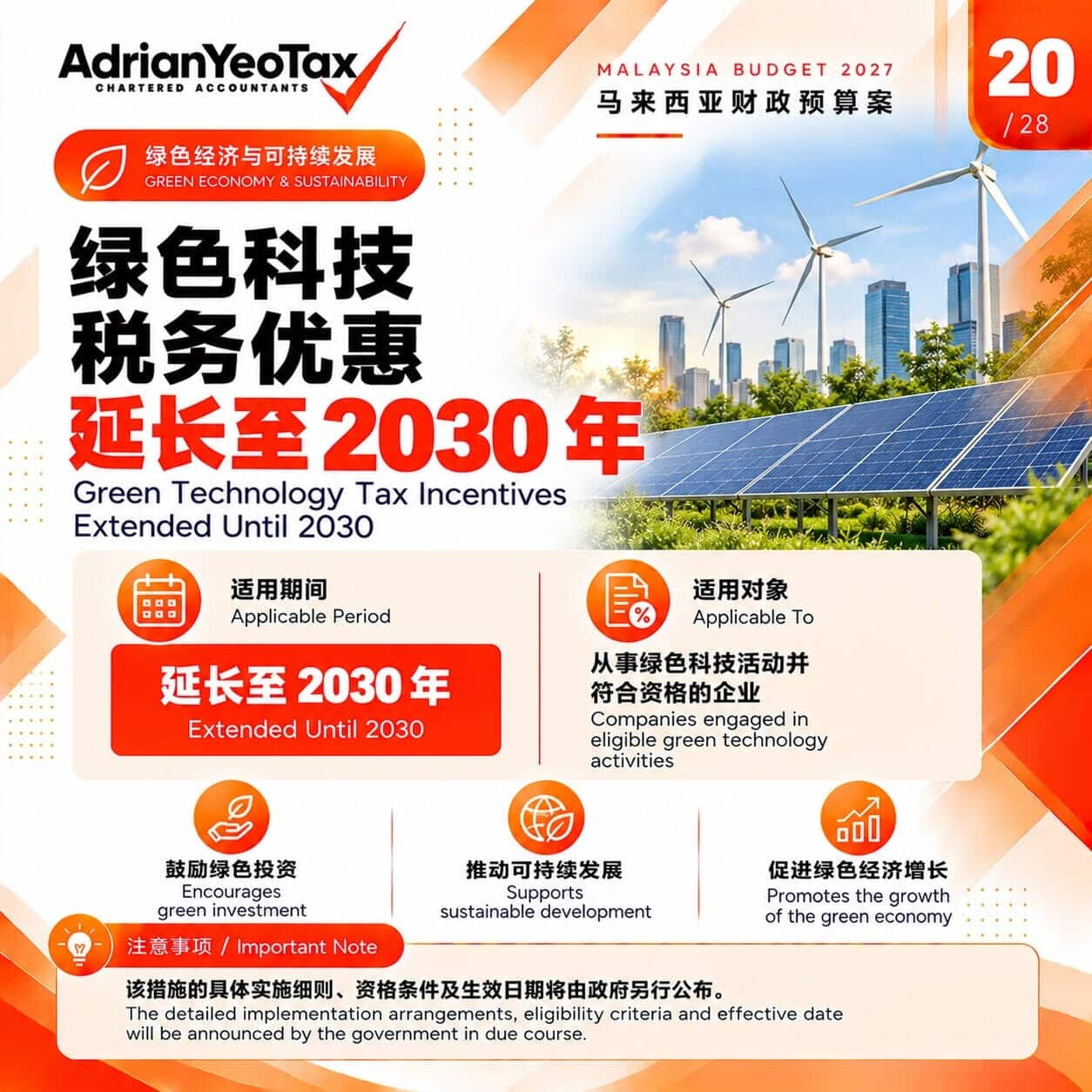
For businesses investing in solar power, energy-efficient equipment or other green technology, Budget 2027 brings useful certainty. The government has announced that tax incentives for green and sustainable technology will be enhanced and extended until 31 December 2030.
What was announced
The Prime Minister announced that tax incentives will be extended to encourage more companies to adopt green and sustainable technology. The extension covers the Green Investment Tax Allowance (GITA) and the Green Technology Financing Scheme, with allowances of up to 100% for qualifying investments.
The previous incentive period was due to end on 31 December 2026, so this gives businesses four more years of planning room.
The incentive categories
Malaysia’s green technology tax incentive has three main parts:
| Incentive | Who it is for |
|---|---|
| GITA Asset | Companies that buy qualifying green technology assets, or undertake projects for their own consumption, where the assets are listed in the MyHijau directory |
| GITA Project | Companies undertaking qualifying green technology projects for business purposes, such as renewable energy generation, EV charging stations and green hydrogen |
| Green Income Tax Exemption (GITE) for solar leasing | Qualifying solar leasing companies listed in the Registered Solar PV Investor Directory |
What the allowance means in practice
GITA is an investment tax allowance. Instead of claiming the usual capital allowance on a qualifying asset, an eligible company can offset a percentage of its qualifying capital expenditure against its statutory income. The allowance can be up to 100%, but it is typically restricted to a percentage of statutory income each year, which spreads the benefit. Please check the final rules for the precise mechanics.
For the asset incentive, reports on the tax measures indicate that it covers qualifying assets purchased from 1 January 2027 to 31 December 2030, as verified by the Malaysian Green Technology and Climate Change Corporation (MGTC).
Not every change is generous
Extensions often come with adjustments. Commentary on the tax measures notes that the proposed amendments for 2027 to 2030 narrow the allowance for EV charging station operators, compared with the existing terms. If your business is in this sector, review the final terms with your adviser before committing to investment.
Who should pay attention?
- Manufacturers and factories looking at energy-efficient machinery or solar installations.
- Property owners and commercial operators considering rooftop solar or energy management systems.
- Companies building renewable energy or EV charging projects.
- Solar leasing providers.
What to do now
- Check your planned capital expenditure. If you are planning green investments, see whether the assets or projects fall within the qualifying categories.
- Check the MyHijau directory. For GITA Asset, the assets need to be on the approved list.
- Plan timing. The incentive window now runs to the end of 2030, which gives you room to phase investments sensibly.
- Check the application route. GITA Asset applications go through MGTC, while GITA Project and GITE solar leasing go through MIDA. Confirm the current process before you commit funds.
- Wait for the final guidelines. The details are subject to the legislation and updated agency guidelines.
Speak to AdrianYeo Tax
Green incentives can be valuable, but they come with strict eligibility and application rules. Our chartered accountants can help you assess your investments and plan your claims.
This article is for general information only and does not constitute tax advice. Measures are based on Budget 2027 announcements and may change when the legislation is finalised. Please consult a tax professional about your specific circumstances.