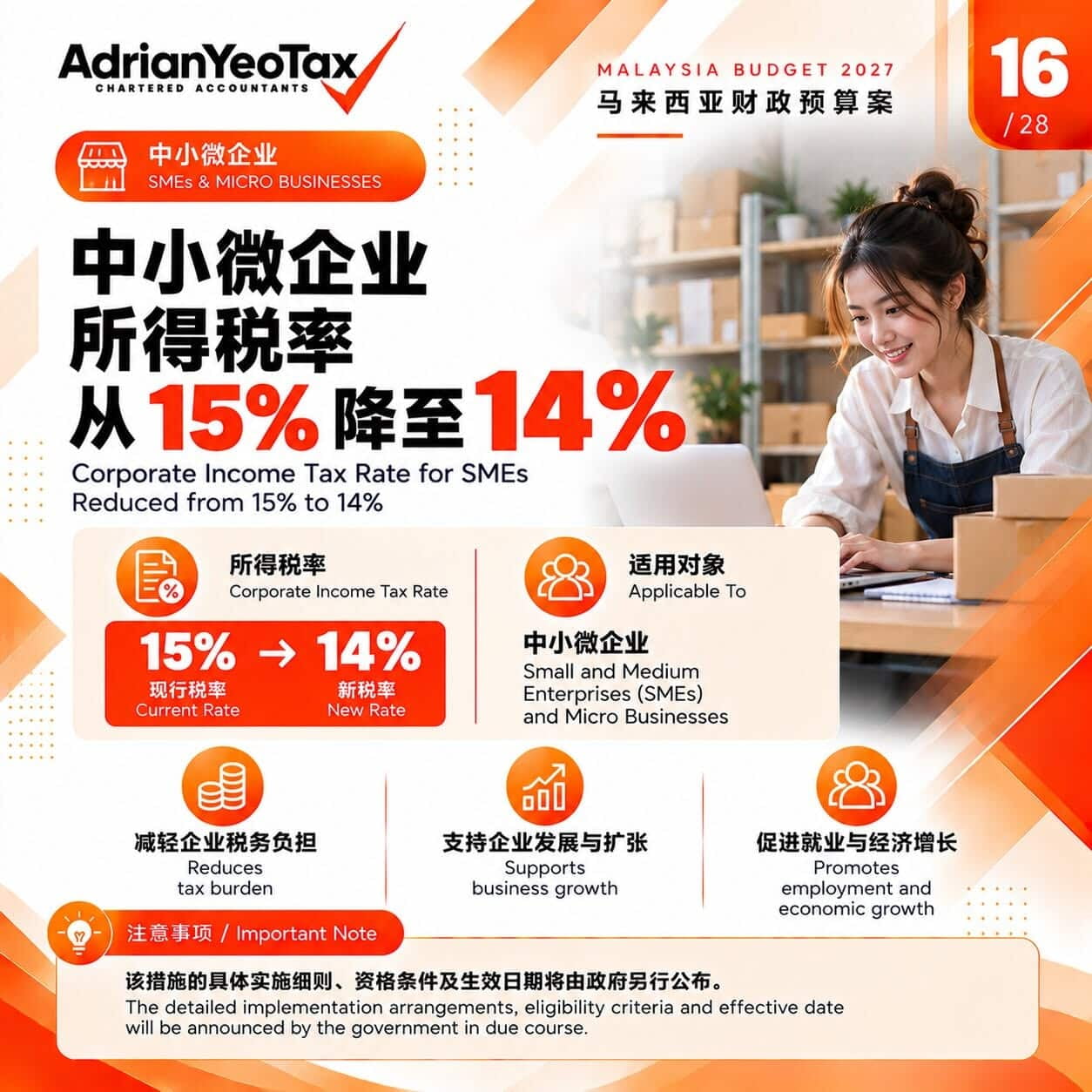
Small businesses carry much of Malaysia’s economy, but they also feel rising costs most sharply. Budget 2027 gives them some breathing room by lowering the preferential corporate tax rates for micro, small and medium enterprises (MSMEs).
What changed
From the 2027 year of assessment, which covers profits earned in the financial year ending in 2027, the preferential rates fall by one percentage point in two bands:
| Chargeable income | Current rate | New rate (from YA 2027) |
|---|---|---|
| First RM150,000 | 15% | 14% |
| RM150,001 to RM600,000 | 17% | 16% |
| Above RM600,000 | 24% | 24% (unchanged) |
The government estimates that about 300,000 MSMEs will benefit, with tax savings of up to RM6,000 each.
Where the RM6,000 comes from
The maximum saving is simple arithmetic. A company with chargeable income of RM600,000 or more gets 1% off the first RM600,000, and 1% of RM600,000 is RM6,000.
For a smaller example, take a company with chargeable income of RM400,000. Under the current rates, tax is RM65,000 (15% of RM150,000 plus 17% of RM250,000). Under the new rates, tax is RM61,000 (14% of RM150,000 plus 16% of RM250,000). The saving is RM4,000. Companies with lower profits save proportionally less, for example RM1,500 on the first RM150,000 alone.
Who qualifies?
The preferential rates are for MSMEs, generally companies or limited liability partnerships with:
- paid-up ordinary share capital (or capital contribution) of RM2.5 million or less, and
- annual sales of not more than RM50 million.
There are also ownership conditions. For example, a company may lose the preferential rates if it is owned above certain thresholds by a related company or by foreign companies. Check these before assuming your company qualifies.
Other measures for businesses
Budget 2027 includes several supporting measures that are worth reviewing alongside the rate cut:
- Small value assets. The cost limit per asset eligible for a full capital allowance claim rises from RM2,000 to RM3,000. For companies other than MSMEs, the annual cap rises from RM20,000 to RM30,000. MSMEs have no annual cap.
- Accelerated capital allowance. The accelerated allowance on locally purchased plant, machinery and ICT equipment is extended to 31 December 2030.
- Stamp duty. Opening a savings or current account will be fully exempt from stamp duty from 1 January 2027.
- Financing. Financing and guarantee facilities for MSMEs rise to a record RM57 billion.
A point for non-MSMEs
Companies other than MSMEs will only be able to claim a tax deduction on salary expenses if wages are paid through bank accounts using channels permitted under the Employment Act 1955. MSMEs are not subject to this rule.
Remember the other side of the budget
The tax cut comes alongside the minimum wage rising to RM2,000 from June 2027. MSMEs with annual sales below RM50 million are temporarily exempt from the new wage rate, but should still plan for it. A sensible approach is to consider the tax saving, higher payroll costs and cash flow together.
What to do now
- Confirm your MSME status. Review paid-up capital, annual sales and shareholding structure.
- Update your tax estimates for YA 2027 using the new rates.
- Review planned asset purchases. The higher small value asset threshold may change the timing and size of your claims.
- Plan cash flow. The tax saving arrives when you pay tax instalments, so adjust your forecasts accordingly.
- Watch for final guidance from the Inland Revenue Board before you file.
Speak to AdrianYeo Tax
Whether you run a micro business or a growing SME, the right structure and planning can make a real difference to your tax. Our chartered accountants can help you assess eligibility and plan ahead.
This article is for general information only and does not constitute tax advice. Measures are based on Budget 2027 announcements and may change when the legislation is finalised. Please consult a tax professional about your specific circumstances.