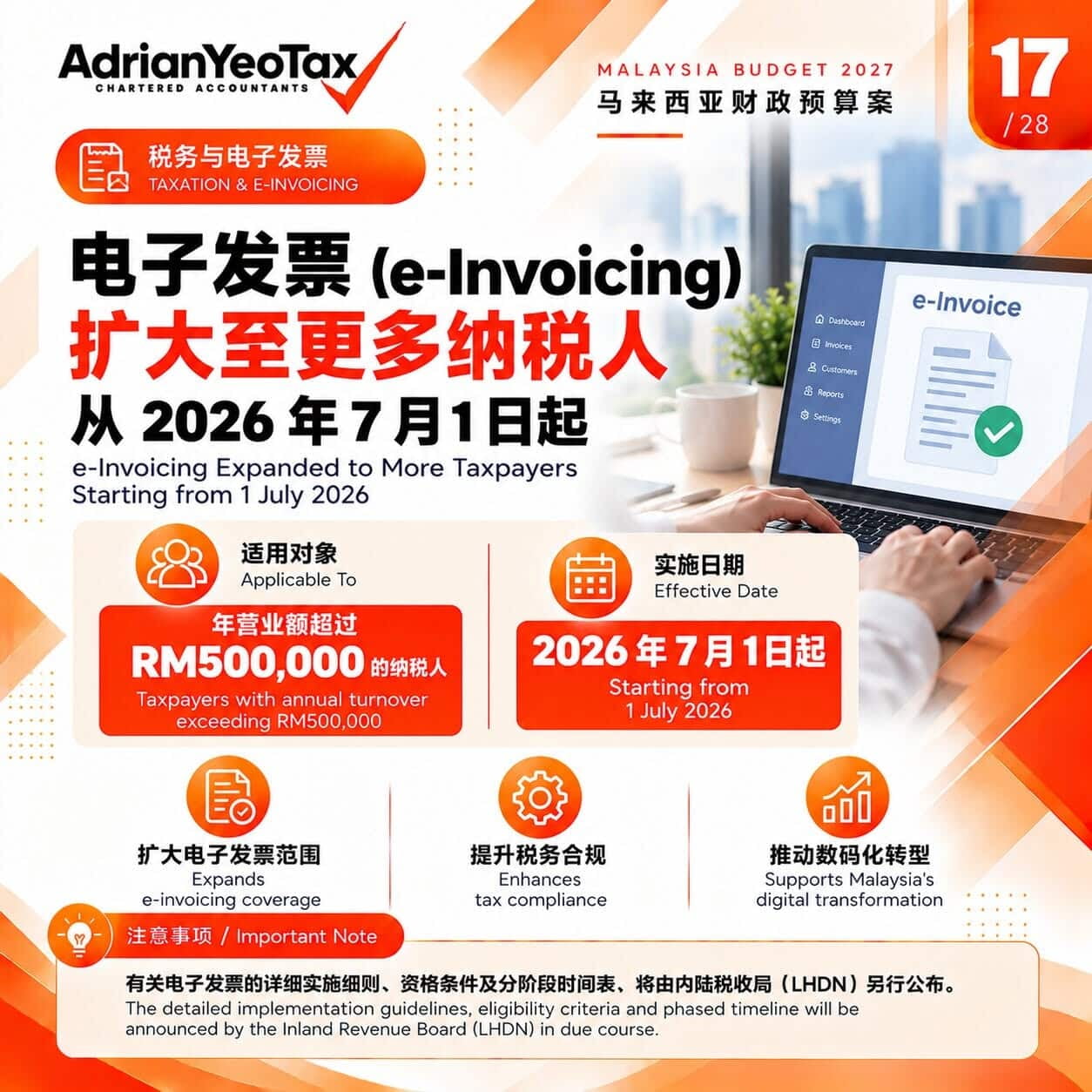
Malaysia’s e-Invoicing rollout has changed several times, and many business owners are no longer sure whether they are covered. If you saw an earlier timeline mentioning RM500,000 and 1 July 2026, please note that it has been superseded. Here is the current position as of November 2026.
This is not a Budget 2027 measure. It is an update from the Inland Revenue Board (LHDN), and we include it because it affects most small businesses.
The big change: RM3 million exemption
Effective 1 September 2026, LHDN raised the e-Invoice exemption threshold from RM1 million to RM3 million in annual turnover or revenue. Micro, small and medium enterprises with annual sales below RM3 million are not required to implement e-Invoicing, and LHDN says this benefits more than 1.1 million businesses. Exempt businesses can still choose to implement e-Invoicing voluntarily.
The exemption is not automatic in every case. A business below RM3 million may still not qualify if it falls into certain prescribed categories, so check the LHDN guideline before you assume you are exempt.
How we got here
| Date | What happened |
|---|---|
| August 2024 | e-Invoicing begins for taxpayers with turnover above RM100 million |
| January 2025 | RM25 million to RM100 million |
| July 2025 | RM5 million to RM25 million |
| December 2025 | Exemption threshold raised from RM500,000 to RM1 million, cancelling the phase planned for 1 July 2026 |
| 1 September 2026 | Exemption threshold raised from RM1 million to RM3 million |
Who still needs to comply?
- Taxpayers above RM5 million are already in the mandatory phases.
- Taxpayers between RM3 million and RM5 million are in scope, but there is a penalty-free relaxation period. Reports on the LHDN specific guideline say it runs until 31 December 2027 for taxpayers with turnover of up to RM5 million. During this period, qualifying businesses may be able to issue consolidated e-invoices, instead of one for every transaction.
- Taxpayers below RM3 million are exempt, subject to the conditions above.
A relaxation period is not an exemption
A penalty-free period softens enforcement. It does not remove the obligation. Businesses in scope should still build e-Invoicing into their systems and workflows, because enforcement is expected to follow when the relaxation ends.
What to do now
- Check your annual turnover against the thresholds. The determination uses the turnover or revenue figures set out in LHDN’s guidelines, so confirm which year applies to you.
- Confirm your exemption conditions. Review the categories that disqualify a business from the exemption.
- If you are in scope, use the relaxation period well. Choose your software, test with MyInvois and train your team.
- If you are exempt, keep records anyway. Customers who are in scope may still ask you for details, and voluntary adoption can help you work with larger clients.
- Check for updates. The thresholds have changed twice in under a year, so review the current LHDN guideline version at least once a year.
Speak to AdrianYeo Tax
e-Invoicing touches your accounting, your software and your tax compliance. Our chartered accountants can help you work out whether you are covered, and our group’s team can support your readiness.
This article is for general information only and does not constitute tax advice. Measures are based on Budget 2027 announcements and may change when the legislation is finalised. Please consult a tax professional about your specific circumstances.